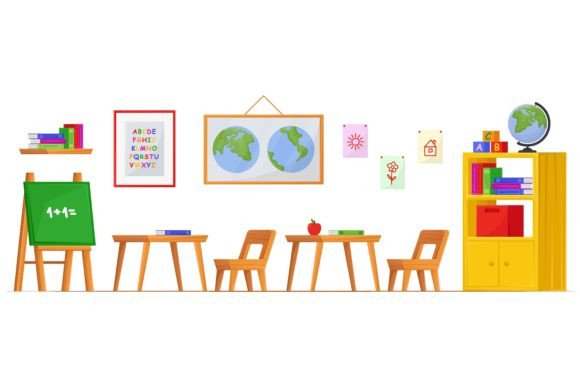
Interior Classrooms in Kindergarten for Drawing, Mathematics, and Creativity
When we think about early childhood education, the physical environment often takes a backseat to curriculum or teacher qualifications. However, interior classrooms in kindergarten for specialized activities like drawing, mathematics, and creative play are not just aesthetic choices; they are foundational tools for cognitive development. The way a room is structured, lit, and furnished directly influences how children engage with complex concepts. A well-designed space does the heavy lifting of classroom management by intuitively guiding behavior and focus.
Consider the difference between a generic, multipurpose room and one tailored for specific learning modalities. In a generic space, toys and books might compete for attention, leading to overstimulation. In contrast, a purpose-built interior creates distinct zones that signal to the child what kind of thinking is required. This subtle environmental cueing helps young minds transition smoothly between high-energy creative bursts and focused analytical tasks.
The Art Zone: Fostering Expression Through Design
Drawing and visual arts are often viewed as "free time," but in a thoughtfully designed interior, they become rigorous exercises in fine motor skills and spatial reasoning. For an art-focused classroom, the primary consideration is mess containment and accessibility. Walls should be treated as canvases, featuring washable surfaces or dedicated mural spaces where children can experiment without fear of reprimand.
Lighting plays a critical role here. Natural light is ideal for color accuracy, but when that is not possible, high-CRI (Color Rendering Index) LED lighting ensures that the red crayon looks truly red, not muddy. Storage solutions must be low and open, allowing children to select materials independently. This autonomy builds confidence and decision-making skills. When shelves are labeled with both images and words, you also sneak in early literacy practice.
A common mistake in designing these spaces is overcrowding tables. Children need elbow room to spread out their work. If the furniture is too cramped, frustration sets in, and the creative process halts. Instead, opt for modular tables that can be pushed together for collaborative projects or separated for individual focus. This flexibility supports both social learning and introspective creation.
Mathematics Corners: Making Abstract Concepts Tangible
Mathematics in kindergarten is rarely about worksheets; it is about pattern recognition, sorting, and understanding quantity. An interior classroom designed for math needs to feel like a laboratory or a construction site rather than a lecture hall. The key is tactile engagement. Flooring can actually serve as a learning tool here. Large grid patterns on carpet tiles or vinyl flooring allow children to physically jump through addition problems or measure distances with their own bodies.
Shelving units in this zone should display manipulatives—blocks, beads, counting bears—in clear, organized containers. The visual order helps children understand categorization, a precursor to algebraic thinking. Low-height whiteboards at eye level encourage spontaneous problem-solving. Unlike paper, whiteboards are low-stakes; mistakes are easily erased, reducing the anxiety often associated with getting the "right" answer.
For educators and parents selecting furniture for this area, durability and stability are paramount. Math activities often involve building and stacking, which can lead to tipping if furniture is lightweight. Heavy, rounded-edge tables provide a stable base for intricate block structures. Furthermore, incorporating vertical space with pegboards allows for hanging measuring tapes, shapes, and number lines, keeping floor space clear for movement-based learning.
Creativity and Imaginative Play Areas
Beyond drawing and numbers, general creativity thrives in spaces that encourage role-play and narrative building. This is where the concept of interior classrooms in kindergarten for imaginative exploration comes alive. These areas often mimic real-world environments—a kitchen, a post office, a doctor’s office. The design goal here is immersion.
Soft furnishings are essential in these zones to dampen sound and create a sense of safety. Rugs define the boundaries of the "stage," helping children understand the scope of their play. Props should be open-ended; a wooden block can be a phone, a car, or a piece of food, whereas a plastic toy phone can only be a phone. Open-ended materials stimulate higher-order thinking and language development as children negotiate roles and scenarios.
Acoustics are frequently overlooked in these designs. Hard surfaces reflect noise, leading to a cacophony that stresses both teachers and students. Incorporating acoustic panels, fabric-covered walls, or heavy curtains can significantly lower ambient noise levels, making it easier for children to hear each other and engage in complex dialogue during play.
Practical Considerations for Different Stakeholders
Designing these spaces is not a one-size-fits-all endeavor. Different stakeholders have unique needs and constraints.
- School Administrators: Focus on longevity and maintenance. Materials must withstand daily wear and tear from hundreds of children. Vinyl flooring, laminate surfaces, and commercial-grade fabrics are worth the initial investment because they reduce long-term replacement costs.
- Teachers: Prioritize visibility and flow. You need to see every corner of the room to ensure safety. Avoid tall bookshelves that create blind spots. Ensure there are clear pathways between zones so that transitions do not result in traffic jams or collisions.
- Parents: Look for signs of intentionality. When touring a kindergarten, observe if the furniture is sized correctly for the children. Are the sinks accessible? Can children reach the supplies without adult help? These details indicate a child-centered approach that respects the learner’s autonomy.
Navigating Limitations and Challenges
While specialized interiors offer immense benefits, they come with challenges. Budget constraints often force compromises. In such cases, prioritize flexibility over specialization. Mobile storage units can transform a corner from a reading nook to a math station in minutes. Paint is another cost-effective tool; a fresh coat of calming blue can define a quiet zone, while bright yellow can energize a creative corner.
Another limitation is the potential for rigid zoning. Children’s learning is holistic; a math activity might inspire a drawing, which leads to a story. If the room is too strictly divided, it can inhibit this natural cross-pollination of ideas. The best interiors balance defined zones with open, neutral spaces that allow for hybrid activities. Keep some central areas empty to accommodate large group gatherings or sprawling projects that defy categorization.
Safety regulations also dictate many design choices. Fire codes may limit the use of certain fabrics or wall hangings. Electrical outlets must be covered or placed high up. While these rules can seem restrictive, they ensure a secure environment where children can explore freely without hidden dangers. Always consult with local safety experts before finalizing any major interior changes.
Integrating Technology Thoughtfully
In modern kindergartens, technology is inevitable, but it should not dominate the interior design. Screens should be integrated subtly, perhaps on rolling carts that can be moved away when not in use, rather than fixed to walls. This preserves the tactile, hands-on nature of early learning. If digital tools are used, ensure they complement physical activities. For example, a tablet might be used to photograph a block structure before it is dismantled, blending digital documentation with physical construction.
Cabling is a major hazard in classrooms. All wires should be concealed within walls or secured tightly along baseboards. Wireless solutions are preferable where possible, reducing clutter and tripping risks. The goal is to make technology invisible until it is needed, ensuring that human interaction remains the primary focus of the classroom experience.
Ultimately, interior classrooms in kindergarten for drawing, mathematics, and creativity are about creating an ecosystem that supports the whole child. By paying attention to light, layout, texture, and accessibility, we create spaces that do not just house education but actively facilitate it. Whether you are renovating an existing school or setting up a home learning environment, remember that every element in the room communicates value to the child. Make sure that message is one of curiosity, safety, and endless possibility.